1

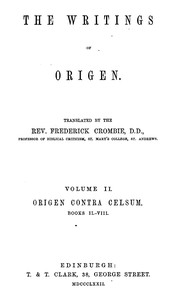
The writings of Origen, Vol. 2 (of 2) — Background and Themes
(0 User reviews)
412
Project Gutenberg
2023
Not confirmed
Theology -- History -- Early Church, ca. 30-600; Celsus (Platonic philosopher), active 180; Apologetics -- History -- Early church, ca. 30-600
Readers of public-domain and historical texts
Project Gutenberg digital edition
en
Edition facts
Words
240,325
Reading time
1045 min
Text sections
46
The writings of Origen, Vol. 2 (of 2) — Background and Themes can be approached with a clearer sense of reading commitment from its source measurements: 240,325 words, 17 hr 25 min estimated reading time, and 46 detected text sections.
The text analysis averages about 33.1 words per sentence, while the detected sections provide another way to judge how the source is divided.
Project Gutenberg metadata also associates the work with “Theology -- History -- Early Church, ca. 30-600,” connecting these edition facts with the source record’s subject description.
Source:
Project Gutenberg record #70693
This second volume of Origen's writings contains the full text of Contra Celsum (Books II–VIII), translated by Frederick Crombie and W. H. Cairns. The excerpts show Origen engaging Celsus's objections with layered argument, moving from straightforward rebuttals to deeper mystical interpretations of Scripture and history.
Read the complete public-domain text at its original source.
Read on Project GutenbergThis volume presents the second half of Origen's Contra Celsum (Books II–VIII), translated by Frederick Crombie and W. H. Cairns. The excerpts reveal a work that is both a point-by-point refutation of the Platonic philosopher Celsus and an exposition of Christian doctrine. Origen frequently shifts between what he calls “the more general and simple class of answers” and “considerations of a profounder kind, conveying a mystical and secret view.” This dual approach—alternating between accessible rebuttal and esoteric interpretation—shapes the entire treatise.
Argumentative Layers in the Excerpts
The excerpts show Origen explicitly distinguishing two levels of response. He first offers “sufficient” answers for “the more general and simple class,” then proposes to “lay down some considerations of a profounder kind.” This structure is not merely rhetorical; it reflects Origen’s conviction that Scripture and history contain both literal and hidden meanings. In the passage on the division of nations, he moves from citing Greek and Egyptian accounts of territorial gods to quoting Moses’ song in Deuteronomy and the Tower of Babel narrative. The shift is abrupt, and Origen does not fully reconcile the two approaches within the excerpt. Readers should note how Origen uses this layered method to address Celsus’s charge that Christian views on piety are merely relative.
Celsus’s Objections as a Structural Device
The analysis of contents at the start of the volume lists Celsus’s objections in sequence: secret associations, barbarous origins, reliance on miracles, and so on. Origen’s replies are organized around these points, but the excerpts show him frequently expanding beyond direct refutation. For instance, when Celsus claims that Christian morality is neither venerable nor new, Origen does not simply defend its antiquity; he instead questions Celsus’s own consistency in accepting Greek and barbarian histories while rejecting Jewish ones. This pattern—taking a specific objection and turning it into a broader epistemological challenge—recurs throughout the text. The catalog subject “Apologetics — History — Early church” is thus concretely embodied in Origen’s method of argument.
The Role of Non-Christian Sources
Origen repeatedly invokes “testimonies outside the word of God” to support his case. In the excerpt, he references “Grecian history” (the contest for Attica), Greek poets, and Egyptian lore about the division of nomes. He even acknowledges that “the learned among the Egyptians can enumerate innumerable instances of this kind.” This willingness to cite pagan sources is notable given the apologetic context. However, Origen also expresses uncertainty: “I do not know whether they include the Jews and their country in this division.” Such admissions of incomplete knowledge are rare in polemical writing and suggest that Origen is working with limited information about non-Christian traditions. The excerpts thus offer a glimpse into the intellectual resources available to a third-century Christian scholar.
Readers approaching this volume should be prepared for a text that moves between straightforward polemic and speculative theology. Origen’s habit of citing both Scripture and pagan sources, and his willingness to acknowledge gaps in his knowledge, make Contra Celsum a richer document than a simple apology. The translation by Crombie and Cairns preserves the density of the original, with long sentences and frequent scriptural quotations. A patient reading, attentive to Origen’s shifts in register, will reward those interested in early Christian thought and its engagement with classical culture.
Returning to the second volume’s unbroken thread of patient argument, I found myself thinking of its predecessor. There is a quiet comfort in how Contra Celsum deepens those earlier conversations, as if the same voice were simply learning to speak longer. The writings of Origen, Vol. 1 (of 2) — Background and Themes feels like an old friend’s opening tone, the first notes before a longer, gentler song.
There are no reviews for this eBook.
There are no comments for this eBook.
Reader reflection
How did this book work for you?
Your answers remain private and are stored only in this browser.
Your progress
0
/
10
2
How much did you enjoy the reading experience?
3
Is this a title you would suggest to others?
4
How much effort did this book require?
5
How strongly did the book affect you emotionally?
6
Is this a title worth rereading?
7
Did you relate to its people, ideas, or situations?
8
How original did the book feel?
9
In one sentence, what did you learn?
10