1

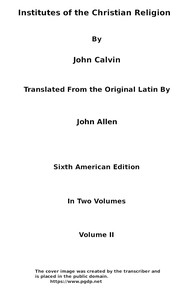
Institutes of the Christian Religion (Vol. 1 of 2) — Reading Companion
(0 User reviews)
92
Project Gutenberg
2014
Not confirmed
Theology, Doctrinal -- Early works to 1800; Reformed Church -- Doctrines -- Early works to 1800
Readers of public-domain and historical texts
Project Gutenberg digital edition
en
Edition facts
Words
325,024
Reading time
1414 min
Text sections
48
This digital edition of Institutes of the Christian Religion (Vol. 1 of 2) — Reading Companion is described by source-level measurements including 325,024 words, 23 hr 34 min estimated reading time, and 48 detected text sections.
The text analysis averages about 32.4 words per sentence, while the detected sections provide another way to judge how the source is divided.
Project Gutenberg metadata also associates the work with “Theology, Doctrinal -- Early works to 1800,” connecting these edition facts with the source record’s subject description.
Source:
Project Gutenberg record #45001
Calvin's systematic theology opens with the mutual knowledge of God and self, then builds through creation, providence, and Scripture's authority. The excerpts show his method of scriptural proof, logical argument, and pastoral application, as seen in his treatment of the fifth commandment with promise and penalty.
Read the complete public-domain text at its original source.
Read on Project GutenbergCalvin begins the Institutes with a striking claim: true wisdom consists in knowledge of God and of ourselves, and these two are intimately connected. The opening chapter, “The Connection Between The Knowledge Of God And The Knowledge Of Ourselves,” sets a pattern for the entire work—each doctrine is grounded in Scripture, clarified by logical reasoning, and directed toward piety. The table of contents reveals a methodical structure: Book I treats the knowledge of God the Creator, moving from natural knowledge to the necessity of Scripture, the Trinity, creation, and providence. Calvin’s voice is precise and authoritative, yet his arguments are built on careful exegesis, as seen in later excerpts where he dissects the fifth commandment.
The Opening Argument: Knowledge of God and Self
The first chapter establishes a dual foundation: “the knowledge of God and the knowledge of ourselves” are intertwined. Calvin argues that without knowing God, we cannot truly know ourselves, and vice versa. This reciprocal relationship drives the entire theological project. The table of contents shows that Book I proceeds from this premise through chapters on natural knowledge, Scripture’s necessity, and the Trinity. The opening is not a simple definition but a dynamic claim that shapes how readers approach every subsequent doctrine. Calvin’s style is dense but orderly; he expects the reader to follow a chain of reasoning that is both scriptural and rational.
Scripture’s Role and the Spirit’s Testimony
Chapters VI through IX address the authority of Scripture. Calvin insists that Scripture is necessary because natural knowledge is insufficient and corrupted by sin. He argues that the Bible’s authority does not depend on the church but on the internal testimony of the Holy Spirit. This is a key polemical point against Catholic claims. The excerpts do not include these chapters in full, but the table of contents lists them: “The Testimony of the Spirit Necessary to Confirm the Scripture” and “Rational Proofs to Establish the Belief of the Scripture.” Calvin’s method is to combine rational arguments with a doctrine of the Spirit’s work in the believer.
Providence and the Governance of the World
Chapters XVI through XVIII treat God’s providence. Calvin affirms that God preserves and governs every part of the world, including the actions of the impious. He is careful to distinguish his view from Stoic fate or mere general oversight. The excerpts do not contain these chapters, but the table of contents shows a progression from creation to providence, then to the proper application of the doctrine. Calvin’s treatment is practical: he wants believers to find comfort in God’s governance, not to speculate idly. The later excerpt on the fifth commandment shows how this providential framework applies to daily life.
The Fifth Commandment: Promise and Penalty
In the extended excerpt on the fifth commandment, Calvin demonstrates his exegetical method. He cites Christ and Paul to show that honoring parents is a requirement of obedience, not a mere suggestion. He explains the promise of long life as a token of God’s favor, not a guarantee of earthly longevity. Calvin argues that even if an obedient child dies young, God still fulfills the promise by giving something better—his favor, which is more richly demonstrated in death. He also notes the curse on the disobedient, citing the death penalty in the law and God’s own punishments. This passage shows Calvin’s blend of scriptural proof, logical reasoning, and pastoral sensitivity.
Readers approaching this first volume should expect a systematic but not dry theology. Calvin’s arguments are always tethered to Scripture, and his goal is piety, not mere knowledge. The table of contents is a reliable guide to the structure, but the real reward is in following how each doctrine connects to the knowledge of God and self. Pay attention to Calvin’s use of Scripture: he often weaves multiple passages together to build a cumulative case. The excerpts show that even in detailed exegesis, his pastoral concern remains visible.
There’s a particular comfort in returning to Calvin’s opening—how knowing God and knowing ourselves remain tangled together. That first volume feels like a slow, careful breath. I find myself thinking of its quieter counterpart, Institutes of the Christian Religion (Vol. 2 of 2) — Background and Themes, almost as a lantern held to those same early steps, illuminating paths I’d missed on earlier walks.
There are no reviews for this eBook.
There are no comments for this eBook.
Reader reflection
Your personal reading reflection
Build a private reading journal entry for this title.
Your progress
0
/
10
2
How much did you enjoy the reading experience?
3
Would you recommend this book to another reader?
4
How much effort did this book require?
5
How clear did the writing feel?
6
Was the book what you thought it would be?
7
Did the story or argument move comfortably?
8
Did the book give you something worth debating?
9
What changed or sharpened your thinking?
10