1

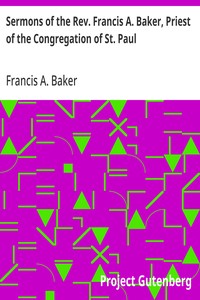
Sermons of the Rev. Francis A. Baker, Priest of the Congregation of St. Paul With a Memoir of His Life — Themes and Context
(0 User reviews)
1299
Project Gutenberg
2019
Not confirmed
Catholic Church -- Sermons; Sermons, American -- 19th century; Baker, Francis A. (Francis Aloysius), 1820-1865
Readers of public-domain and historical texts
Project Gutenberg digital edition
en
Edition facts
Words
181,280
Reading time
789 min
Text sections
20
Sermons of the Rev. Francis A. Baker, Priest of the Congregation of St. Paul With a Memoir of His Life — Themes and Context can be approached with a clearer sense of reading commitment from its source measurements: 181,280 words, 13 hr 9 min estimated reading time, and 20 detected text sections.
The text analysis averages about 20.5 words per sentence, while the detected sections provide another way to judge how the source is divided.
Project Gutenberg metadata also associates the work with “Catholic Church -- Sermons,” connecting these edition facts with the source record’s subject description.
Source:
Project Gutenberg record #58812
A mid-19th-century collection of Catholic sermons by Francis A. Baker, preceded by a memoir from his close associate A. F. Hewit. The excerpts reveal a rhetorical style that blends scriptural exegesis with direct, emotional appeals to the congregation, particularly on the beatific vision and the nature of heavenly joy.
Read the complete public-domain text at its original source.
Read on Project GutenbergThe volume opens not with a sermon but with a memoir by A. F. Hewit, who acknowledges having woven his own history into the narrative due to his close connection with Baker. The preface frames the work as both a personal tribute and a public example of conversion to Catholicism, aiming to promote divine glory. The sermons themselves, as seen in the excerpt on heaven, employ a direct, exhortatory style: Baker repeatedly addresses his listeners as “my brethren,” “young men,” and “children,” and uses rhetorical questions to draw them into reflection on their own experiences of happiness and sin.
Memoir as Personal and Doctrinal Frame
The memoir by A. F. Hewit is not a detached biography but a deeply personal account. Hewit describes the “close connexion between myself and the one whose career I have been describing,” and admits that his own reflections “have woven themselves in spontaneously” into the narrative. This intertwining suggests that the memoir serves as both a record of Baker’s life and a testament to Hewit’s own spiritual journey. The preface explicitly states a dual motive: to perpetuate Baker’s memory and to promote the glory of God by showcasing a “signal conversion.” Readers should expect the memoir to blend factual detail with theological reflection, and to present Baker’s life as a model of faith rather than a neutral chronicle.
Rhetorical Strategies in the Sermons
The excerpt on heaven illustrates Baker’s homiletic technique. He builds his argument on scriptural quotations—from John, Paul, and the Psalms—but then shifts to direct, emotional engagement. He asks, “Tell me, tell me, young men, tell me, children, tell me truly, one and all, what have been the happiest moments of your life?” and contrasts sinful moments with times of prayer or confession. This pattern of moving from doctrine to personal application is characteristic. Baker also uses vivid contrasts: the “pale and indistinct sketch” of memory versus the “coloring and animation of life,” and the earthly experience of thinking about God versus the heavenly vision. His language is concrete and sensory, speaking of “the music of His voice and the perfume of His breath.”
The Beatific Vision as Central Theme
A substantial portion of the excerpt focuses on the beatific vision—the direct sight of God in heaven. Baker emphasizes that humans naturally lack the faculty to see God, citing “No man hath seen God at any time.” He explains that a transformation is needed, a “light of glory” that makes the soul “divine and godlike.” This theological point is then made personal: heaven is described as a “fatherland,” a “lost inheritance recovered,” where the soul enjoys “intimate communication of thought and feeling” with God. Baker’s treatment is notable for its affective intensity; he describes God’s “towering altitudes” and the soul being “upborne by His power and goodness.” The sermon thus combines doctrinal exposition with an urgent, pastoral appeal to desire this joy.
Readers approaching this volume should note that the sermons are embedded in a specific historical and personal context. The memoir by Hewit provides essential background on Baker’s conversion and ministry, but it is not a neutral account. The sermons themselves are best read as performances of mid-19th-century Catholic preaching, characterized by scriptural grounding, emotional directness, and a focus on the afterlife. The excerpts suggest that Baker’s style is more hortatory than speculative, aiming to move his congregation toward a deeper longing for God.
That rainy afternoon, Sermons of the Rev. Francis A. Baker kept me company, his words on heavenly joy feeling oddly close, almost tangible. Later, thumbing the index, I stumbled onto a footnote about Luther’s own careful distinctions on faith and works. Somehow that led me to The Smalcald Articles — Key Ideas to Explore, a quieter, sterner voice, yet one that answered a question Baker had only opened.
There are no reviews for this eBook.
There are no comments for this eBook.
Reader reflection
What did you think of this book?
Answer a few questions and save a private reflection on this device.
Your progress
0
/
10
2
How much did you enjoy the reading experience?
3
How likely are you to recommend this book?
4
Did the language feel accessible?
5
Did you gain anything practical from the text?
6
How strongly did the book affect you emotionally?
7
Was the book moving at the right speed?
8
How personally connected did you feel to the book?
9
What is the main idea you are taking away?
10