1

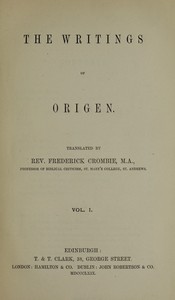
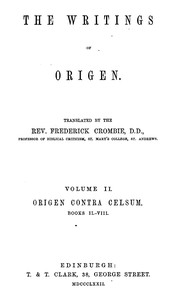
The writings of Origen, Vol. 1 (of 2) — Background and Themes
(0 User reviews)
181
Project Gutenberg
2023
Not confirmed
Theology -- History -- Early Church, ca. 30-600; Celsus (Platonic philosopher), active 180; Apologetics -- History -- Early church, ca. 30-600
Readers of public-domain and historical texts
Project Gutenberg digital edition
en
Edition facts
Words
179,418
Reading time
781 min
Text sections
31
The writings of Origen, Vol. 1 (of 2) — Background and Themes can be approached with a clearer sense of reading commitment from its source measurements: 179,418 words, 13 hr 1 min estimated reading time, and 31 detected text sections.
The text analysis averages about 33.9 words per sentence, while the detected sections provide another way to judge how the source is divided.
Project Gutenberg metadata also associates the work with “Theology -- History -- Early Church, ca. 30-600,” connecting these edition facts with the source record’s subject description.
Source:
Project Gutenberg record #70561
This editorial note examines how Origen's De Principiis, letters, and Contra Celsum unfold through their opening arguments, dialectical method, and scriptural reasoning, guiding a first reading of this 1869 translation.
Read the complete public-domain text at its original source.
Read on Project GutenbergThe volume opens with Origen’s De Principiis, a systematic treatise that immediately confronts the reader with a dialectical method: Origen presents opposing views on a question—such as whether the flesh has its own wisdom—then weighs them, leaving the reader to choose. In the excerpt on “carnal wisdom,” he argues that phrases like “the wisdom of the flesh” are catachrestic, not literal, and warns against heretical conclusions that would impugn God’s justice. This pattern of framing a puzzle, citing scripture, and adjudicating between interpretations recurs throughout the work.
A Dialectical Opening
The first book of De Principiis begins with God, Christ, and the Holy Spirit, but the excerpt on “carnal wisdom” shows Origen’s characteristic move: he raises a difficulty—how can a good God create something hostile to Himself?—then reviews how “they” (opponents or fellow inquirers) understand the text. He notes that the phrase “the flesh lusteth against the spirit” is not literal but an “abuse of language,” akin to saying the earth is thirsty. This careful parsing of scriptural language is central to his method. He does not simply assert a position; he stages a debate, then invites the reader to decide. The passage ends with “let the reader choose out of them for himself that which he thinks ought to be preferred,” a direct appeal that makes the reader an active participant.
Scripture as a Field of Argument
Origen’s reasoning is anchored in specific biblical verses. In the excerpt, he cites Romans 8:7 (“the wisdom of the flesh is enmity against God”), Galatians 5:17 (“the flesh lusteth against the spirit”), and Genesis 4:10 (“the voice of thy brother’s blood crieth”). He treats these not as proof texts but as sites of interpretive conflict. For instance, he argues that “the voice of thy brother’s blood” is an improper expression for vengeance, not a literal cry. This approach reveals a key feature of his theology: he insists that scripture must be read with attention to figurative language, lest one attribute hostility to God’s own creation. The reader should watch for how Origen consistently distinguishes between literal and catachrestic uses of terms, a habit that shapes his entire system.
The Question of Time and Creation
In Chapter V of Book III, Origen turns to the world’s beginning in time, a topic he says is “held principally in consequence of our belief in the truth of our sacred history.” He acknowledges that the world was created at a certain time and will be destroyed “on account of its corruption.” This passage, though brief in the excerpt, signals a shift from anthropological to cosmological questions. Origen’s method remains the same: he presents the church’s article of faith, then proposes to “re-discuss a few points.” The reader will find that De Principiis moves fluidly between scriptural exegesis, philosophical reasoning, and doxological reflection. The later books, including the letters and Contra Celsum, extend this method to historical and polemical contexts.
From Treatise to Correspondence
The volume includes two letters: one from Africanus to Origen concerning the History of Susanna, and Origen’s reply. These letters offer a more personal glimpse of Origen’s exegetical practice. The correspondence with Africanus deals with textual authenticity and canonical boundaries, topics that complement the abstract arguments of De Principiis. The letter to Gregory (likely Gregory Thaumaturgus) provides practical guidance on reading scripture. Finally, the first book of Contra Celsum opens Origen’s apologetic work against the Platonic philosopher Celsus. Readers should note how Origen adapts his dialectical style to a direct opponent, using many of the same interpretive strategies seen in the earlier treatise.
First-time readers will benefit from tracking Origen’s habit of posing a question, reviewing multiple interpretations, and then leaving judgment open. The excerpts show a thinker who treats scripture as a living text requiring careful linguistic and theological analysis. Pay attention to his use of “catachrestic” and “improper” language—these terms signal where he is doing his most important work. The volume’s structure, moving from systematic theology to correspondence to polemic, offers a rounded introduction to Origen’s mind.
Reading how Origen lets his questions breathe, waiting patiently in the margins of scripture, I was reminded of evenings spent with an old Victorian minister’s quiet discomfort with easy faith. His measured unease felt familiar, like a door left ajar—never slammed. That same honest hesitancy, the ache of true belief versus comfortable custom, lingers in A Practical View of the Prevailing Religious System of Professed Christians, in the Middle and Higher Classes in this Country, Contrasted with Real Christianity. — Key Ideas to Explore. Both books ask quietly, what do we actually hold?
There are no reviews for this eBook.
There are no comments for this eBook.
Reader reflection
Your personal reading reflection
Build a private reading journal entry for this title.
Your progress
0
/
10
2
How much did you enjoy the reading experience?
3
Would you recommend this book to another reader?
4
How demanding did the text feel?
5
How much did the book move you?
6
How personally connected did you feel to the book?
7
How useful did the reading feel?
8
Was the book easy to understand?
9
What did this book teach you most?
10