About 219 minutes
Atheism in Pagan Antiquity — Background and Themes
Theology
50,148 recorded words. 8 minutes difference from this book's estimate.
View Gutenberg source #28312
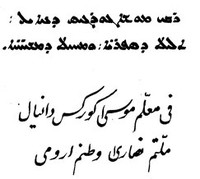
This digital edition of Modern Persia — Reading Notes is described by source-level measurements including 48,359 words, 3 hr 31 min estimated reading time, and 6 detected text sections.
The text analysis averages about 16.9 words per sentence, while the detected sections provide another way to judge how the source is divided.
Project Gutenberg metadata also associates the work with “Islam,” connecting these edition facts with the source record’s subject description.
Explore this collection
These alternatives are selected using recorded categories and estimated reading time.
About 219 minutes
Theology
50,148 recorded words. 8 minutes difference from this book's estimate.
View Gutenberg source #28312About 221 minutes
Theology
50,634 recorded words. 10 minutes difference from this book's estimate.
View Gutenberg source #30209About 200 minutes
Theology
45,845 recorded words. 11 minutes difference from this book's estimate.
View Gutenberg source #8024Search stored excerpts and compare books → Choose by your preferences →
Choices use stored catalog measurements. Estimates vary with reading speed. A shared category is a catalog label, not a claim that two books have the same argument or literary quality.
Search reads excerpt text stored with this catalog and links to its associated Gutenberg record. The connection is stored in the site database; this tool does not recheck that every excerpt is word-for-word identical to that external record. Excerpt search does not cover every chapter and does not verify historical publication dates.
Catalog snapshot checked: 2026-09-25. Coverage: 99 public books, 99 available source excerpts.
Read the complete public-domain text at its original source.
Read on Project GutenbergRabbi Mooshie G. Daniel, a native of Persia and professor at McCormick Seminary, wrote Modern Persia in 1897 to answer questions from Americans about the country's government, religion, and mission work. The preface frames the book as a corrective to misrepresentations by traveling journalists and as an encouragement to foreign missions. Daniel's tone is direct and confessional, as when he asks, 'Oh, Jehovah of the East! When wilt thou again visit the East?' The work is structured in two parts: a general survey of Persia and a detailed examination of Islam, with a strong comparative Christian perspective.
The preface reveals that Daniel wrote in response to specific queries from 'godly ministers and devoted people' about the fruits of mission work in Persia. He cites a letter from Rev. O. N. Hunt asking about the 'moral condition of Persia to-day in comparison to what it was when the missionaries began their work.' This question drives the book's apologetic framework. Daniel does not claim to be neutral; his stated object is 'to encourage the mission spirit' and 'to hasten the day when millions that now sit in darkness... may set their faces toward the light.' The reader should expect a work that measures Persian society against Christian moral standards, not an ethnographic survey.
Daniel devotes considerable attention to Shiite religious practices, particularly the ten-day mourning period for Hussein. He describes believers shouting, 'O Hassan and Hussein, let my soul be a sacrifice for thee,' and notes that some preserve tears in bottles as relics, citing the Psalmist's phrase 'Put thou my tears in thy bottle.' The account includes vivid details: barefoot processions of governors with servants, and men walking around mosques to stay awake during the final night. Daniel emphasizes that 'not one word is said in condemnation of sin' during these ceremonies, a claim that frames the rituals as morally empty compared to Christian teaching.
In the chapter on heaven and hell, Daniel outlines Islamic eschatology based on the Koran. He describes seven heavens, with the highest reserved for prophets and martyrs, and Mohammed as 'mediator between God and believers.' The earthly paradise includes gardens, vineyards, and 'many bathing pools of glass.' A striking numerical detail: each vine bears '7,000 clusters of grapes, and every grape contains 7,000 gallons of juice.' Daniel also reports that ordinary believers receive '72 houries or female angels,' with more for martyrs. These descriptions are presented as factual summaries, but the tone implies criticism of what Daniel sees as a materialistic and sensual conception of the afterlife.
Daniel identifies himself as 'Rabbi Mooshie G. Daniel, McCormick Seminary' and notes his previous role as 'Professor of Ancient Syriac in Oroomiah College, Persia.' He acknowledges using the International Encyclopedia for dates and Dr. Philip Schaff's Church History for the account of Mohammed. The book is dedicated to the Class of 1897 of McCormick Theological Seminary. These details situate the work within a specific late-19th-century American Protestant missionary context. Readers should note that Daniel writes as an insider to Persian culture but an outsider to Islam, and his comparisons consistently elevate Christianity as 'the sun shining in its fulness' against 'the darkness of midnight.'
Daniel's Modern Persia is best read as a primary source on how an educated Persian Christian presented his homeland to an American audience at the turn of the century. The book's value lies less in its factual accuracy about Islam—which is filtered through a polemical lens—than in its documentation of missionary attitudes and the specific questions Americans asked about Persia. Readers interested in comparative religion should supplement this text with works from Islamic perspectives.
Reading about Persia’s Shiite beliefs, I remembered sitting on my grandfather’s porch while he described the afterlife in whispers, his hands still. That hush returned when I later found Egyptian Ideas of the Future Life — Reading Companion, its old pages carrying the same patient wonder. Two distant worlds, yet both left me feeling the quiet weight of what people hold sacred.
A brief reflection can help important ideas stay with you longer.