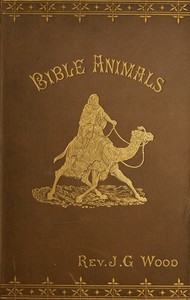
Bible animals — Edition Insights

(5 User reviews)   1541
Wood, J. G. (John George), 1827-1889, Keyl, Friedrich Wilhelm, 1823-1871 [Illustrator], Smith, E. A. (Edgar Albert), 1847-1916 [Illustrator], Wood, T. W. (Thomas W.), 1839-1910? [Illustrator] Project Gutenberg 2013 Not confirmed
Animals in the Bible; Nature in the Bible Readers of public-domain and historical texts
Project Gutenberg digital edition en

Edition facts

Words 249,231
Reading time 1084 min
Text sections 29

The source record for Bible animals — Edition Insights measures this digital text at 249,231 words, 18 hr 4 min estimated reading time, and 29 detected text sections.

The text analysis averages about 27.5 words per sentence, while the detected sections provide another way to judge how the source is divided.

Project Gutenberg metadata also associates the work with “Animals in the Bible,” connecting these edition facts with the source record’s subject description.

This editorial note examines J. G. Wood's authorial choices in diction, dialogue, and description within 'Bible Animals,' focusing on how he blends zoological detail with scriptural exegesis, using classical and archaeological references to illuminate biblical passages.
Share
Editorial Edition Score 4.9/5

Calculated from edition completeness, EPUB availability, text structure and catalogue metadata. Not a user rating.

How this score is calculated
  • Description quality20 pts
  • Title & short description10 pts
  • Source metadata20 pts
  • Text length15 pts
  • Chapters / structure15 pts
  • EPUB file integrity20 pts

Total of 100 points, scaled to a 2.5-5.0 range. Editions with an empty description or a missing EPUB file are not scored.

Edition quality

Read the Text

two species of Camel, and the mode of distinguishing them--Value of the Camel in the East--Camels mentioned as elements of wealth--Uses of the Camel--The Jews forbidden to eat its flesh--The milk of the Camel--Thirst-enduring capability--The internal reservoir--The hump, and its uses to the animal--The Camel as a beast of draught and burden--How the Camel is laden--Knowledge of its own powers--Camels for riding--Difficulty of sitting a Camel--A rough-paced steed--Method of guiding the Camel--The mesh'ab, or Camel-stick of office--The women's saddle--Rachel's stratagem--Ornaments of the Camel--The swift dromedary, Heirie, or Deloul--Its ungainly aspect--Speed and endurance of the Deloul--The Camel-posts of Bornu--Camel-drivers and their conduct--The driver's song--Young Camels and their appearance--The deserted Camel 216

The Camel and its master--Occasional fury of the animal--A boy killed by a Camel--Another instance of an infuriated Camel--Theory respecting the Arab and his Camel--Apparent stupidity of the Camel--Its hatred of a load, and mode of expressing its disapprobation--Riding a Camel through the streets--A narrow escape--Ceremony of weaning a young Camel--The Camel's favourite food--Structure of the foot and adaptation to locality--Difficulty in provisioning--Camel's hair and skin--Sal-ammoniac and desert fuel--The Camel and the needle's eye--Straining at a gnat and swallowing a Camel 233

General description of the animal--Its use in mountain roads--Peculiar formation of the foot--Uses of a mixed breed--Its power of enduring cold--Used chiefly as a beast of draught--Unfitness for the plough--The cart and mode of harnessing--The load which it can draw--Camel-skin ropes--A Rabbinical legend 244

The Hebrew words which signify the Horse--The Horse introduced into Palestine from Egypt--Similarity of the war-horse of Scripture and the Arab horse of the present day--Characteristics of the Horse--Courage and endurance of the Horse--Hardness of its unshod hoofs--Love of the Arab for his Horse--Difficulty of purchasing the animal--The Horse prohibited to the Israelites--Solomon's disregard of the edict--The war-chariot, its form and use--Probable construction of the iron chariot--The cavalry Horse--Lack of personal interest in the animal 248

Importance of the Ass in the East--Its general use for the saddle--Riding the Ass not a mark of humility--The triumphal entry--White Asses--Character of the Scriptural Ass--Saddling the Ass--The Ass used in agriculture--The Ass's millstone--The water-wheel and the plough--Reminiscences of the Ass in the Scriptural narrative--Its value as property--The flesh of the Ass--The siege of Samaria and its horrors--Various legends respecting the Ass--The impostor and his fate--Samson and Balaam 264

The Arod and Pere of Scripture--Various allusions to the Wild Ass--Its swiftness and wildness--The Wild Ass of Asia and Africa--Knowledge of the animal displayed by the sacred writers--How the Wild Ass is hunted--Excellence of its flesh--Sir R. K. Porter's meeting with a Wild Ass--Origin of the domestic Ass--The Wild Asses of Quito 279

Ancient use of the Mule--Various breeds of Mule--Supposed date of its introduction into Palestine--Mule-breeding forbidden to the Jews--The Mule as a saddle-animal--Its use on occasions of state--The king's Mule--Mules brought from Babylon after the captivity--Obstinacy of the Mule--The Mule as a beast of burden--The "Mule's burden" of earth--Mules imported by the Phoenicians--Legends respecting the Mule 285

The Mosaic prohibition of the pig--Hatred of Swine by Jews and Mahometans--A strange use of bacon--The prodigal son--Resistance to the prosecution of Antiochus--Swine hated by the early Egyptians--Supposed connexion between Swine and diseases of the skin--Destruction of the herd of Swine--The locality of the event discovered--Pigs bred for the monasteries--The jewel of gold in a Swine's snout--The wild boar of the woods, and the beast of the reeds--The damage which it does to the vines--General account of the wild boar of Palestine--Excellence of its flesh 292

The Elephant indirectly mentioned in the Authorized Version--Solomon's ivory throne--Ivory used in Egypt--Horns of ivory--The ivory palaces--Beds of ivory--The Tyrian ships--Ivory mentioned by Homer--Vessels of ivory--The Elephant as an engine of war--Antiochus and his Elephants--Oriental exaggeration--Self-devotion of Eleazar--Attacking the Elephants, and their gradual abandonment in war--The Talmudical writers on the Elephant--A funeral and an omen 302

The Shaphan of Scripture, and the correct meaning of the word--Identification of the Shaphan with the Syrian Hyrax--Description of the animal--Its feet, teeth, and apparent rumination--Passages in which the Coney is mentioned--Habits of the animal--Its activity and wariness--The South African Hyrax, and its mode of life--Difficulty of procuring it--Similarity in appearance and habits of the Syrian species--Three species of Hyrax known to naturalists--The Talmudical writers on the Shaphan--The jerboa and the rabbit--A curious speculation and a judicious compromise 312

Literal translation of the word _Behemoth_--Various theories respecting the identity of the animal--The Hippopotamus known to the ancient Hebrews--Geographical range of the animal--"He eateth grass like the ox"--Ravages of the Hippopotamus among the crops--Structure of the mouth and teeth--The "sword or scythe" of the Hippopotamus--Some strange theories--Haunts of the Hippopotamus--The Egyptian hunter--A valuable painting--Strength of the Hippopotamus--Rising of the Nile--Modern hunters--Wariness of the Hippopotamus--The pitfall and the drop-trap 318

THE LÄMMERGEIER, OR OSSIFRAGE OF SCRIPTURE.

J. G. Wood's Bible Animals opens with a striking claim: without natural history, readers will 'misinterpret instead of rightly comprehending' Scripture. This conviction shapes every page, as Wood treats zoology not as a supplement but as an essential hermeneutic tool. His preface frames the work as a duty, not a diversion, and the ensuing chapters bear out that seriousness. Wood moves fluidly between biblical verses, classical poetry, and contemporary archaeological finds—such as Layard's discoveries at Nineveh—to ground each animal in its historical and literary context. The result is a text that reads as both a naturalist's field guide and a theologian's commentary, with a distinctive voice that is learned, precise, and occasionally polemical.

Diction: The Lexicon of Authority

Wood's word choices consistently assert his authority as a naturalist and scholar. He deploys technical terms like 'ethnology' and 'philology' alongside vivid verbs such as 'scorneth' (from the Job epigraph) and 'boding.' His descriptions of ivory as 'costly ornament' and elephants as 'engines of war' reflect a deliberate blending of biblical and classical registers. In discussing the elephant, he quotes the Apocrypha and then immediately cites Homer's Iliad, using phrases like 'the iv'ry studded reins' to create a tapestry of authoritative sources. This diction establishes Wood as a mediator between ancient texts and modern readers, positioning his work as indispensable for true understanding.

Dialogue: The Absent Voices

Notably, Wood's text contains almost no direct dialogue. The voices that appear are those of Scripture—quoted verses from Job, Amos, Ezekiel, and Revelation—and of classical authors like Homer. Wood himself speaks in a monologic, expository tone, rarely ventriloquizing animals or biblical figures. When he does approach dialogue, it is through indirect paraphrase: 'the King of Egypt was so alarmed... that he ran away.' This absence of direct speech reinforces the book's scholarly distance; Wood is not dramatizing but explicating. The effect is to center the biblical text as the primary speaker, with Wood as its interpreter.

Description: The Visual and the Archaeological

Wood's descriptive passages are notable for their reliance on visual and material evidence. He describes ivory 'in its original state as imported—the uncut tusks, or "horns of ivory"' and details the construction of war elephants with 'strong towers of wood' and 'thirty-two strong men' atop each beast. These descriptions are anchored in archaeological findings, such as Layard's Nineveh excavations, which Wood cites to confirm prophetic accuracy. His prose often moves from the general to the specific: after noting that ivory was used for 'beds of ivory' in Amos, he specifies that Ulysses made his own bed 'of hide thongs interlaced, and inlaid the posts with gold, ivory, and silver.' This method grounds abstract biblical references in tangible, historical objects.

Structure: Thematic Clusters and Scriptural Anchors

Wood organizes each entry around a biblical verse or passage, then expands outward into natural history, classical parallels, and archaeological evidence. The chapter on the elephant, for instance, begins with a verse from Job, then moves to a detailed analysis of ivory in the Old Testament and Apocrypha, then to Greek and Roman authors, and finally to the elephant's role in warfare. This structure creates a layered argument: each animal is a node connecting Scripture, history, and science. Wood's transitions are often abrupt, signaled by phrases like 'Having now examined... we turn to...' which give the text a lecture-like cadence. The result is a work that feels encyclopedic yet purposeful, each section building a case for the zoological foundation of biblical interpretation.

Wood's Bible Animals rewards readers who approach it as a work of synthesis rather than a simple reference. Pay attention to how he selects and juxtaposes sources—a verse from Amos, a line from Pope's Homer, a report from Layard's dig—to construct a web of meaning. The book's value lies not in its zoological accuracy (which may be dated) but in its method: a Victorian clergyman's attempt to reconcile faith with empirical science. For modern readers, it offers a window into 19th-century biblical scholarship and the intellectual currents that shaped it.

Flipping through Bible Animals, I lingered on how J. G. Wood lets a camel’s gait or a sparrow’s nesting habits quietly illuminate a verse, without forcing the point. It reminded me of another voice, equally patient, tracing the breath beneath Ecclesiastes’ skepticism. There’s a shared tenderness there, a willingness to sit with the text until it speaks. That feeling surfaced again in Expositor's Bible: The Book of Ecclesiastes — Background and Themes, and I smiled at the kinship.

James Ramirez
3 weeks ago

Evelyn Moore
1 month ago

Amelia Nelson
3 weeks ago

Noah Mitchell
1 month ago

Victoria Allen
1 month ago

5
5 out of 5 (5 User reviews )

Add a Review

Your Rating *
  • ...
    Reginald Ponce - 1 month ago
    Bible Animals is a fascinating exploration of the creatures mentioned in the Bible, blending natural history with scriptural context. The author's meticulous research brings each animal to life, enriching my understanding of biblical passages. The illustrations are beautiful and the writing is engaging, making it a perfect resource for both scholars and curious readers. I highly recommend it to anyone interested in the intersection of faith and nature.

  • ...
    Charles Bell - 4 weeks ago
    While the concept is intriguing, Bible Animals falls short in execution. The text is dry and reads like a list rather than a compelling narrative. There's little engagement with the symbolic or theological significance of the animals, and the illustrations are dated. I was hoping for a richer exploration but found it superficial. It might serve as a basic reference, but do not expect a profound study.

  • ...
    Erin Pollard - 2 weeks ago
    This book provides an interesting overview of animals in the Bible, with clear explanations and biblical references. It's a decent reference for quick look-ups, but the lack of deeper ecological or cultural analysis left me wanting more. Still, it's a handy addition to any biblical studies library, especially for visual learners who appreciate the accompanying artwork.


Reader reflection

How did this book work for you?

Your answers remain private and are stored only in this browser.

Your progress 0 / 10
1

Have you finished this book?

2

How much did you enjoy the reading experience?

3

How likely are you to recommend this book?

4

What was the reading difficulty like?

Related eBooks