1

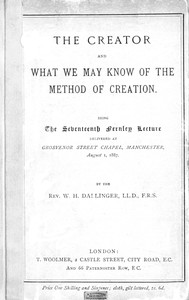
The Creator, and what we may know of the method of creation — Story, Setting & Ideas
(0 User reviews)
810
Project Gutenberg
2023
Not confirmed
Religion and science; Evolution; Creation; God
Readers of public-domain and historical texts
Project Gutenberg digital edition
en
Edition facts
Words
29,073
Reading time
127 min
Text sections
5
For The Creator, and what we may know of the method of creation — Story, Setting & Ideas, the stored edition analysis reports 29,073 words, 2 hr 7 min estimated reading time, and 5 detected text sections.
The text analysis averages about 21.7 words per sentence, while the detected sections provide another way to judge how the source is divided.
Project Gutenberg metadata also associates the work with “Religion and science,” connecting these edition facts with the source record’s subject description.
Source:
Project Gutenberg record #70115
In this 1887 Fernley Lecture, W. H. Dallinger, a Fellow of the Royal Society, argues that mind cannot arise from matter, using philosophical reasoning and critiques of Hume, Comte, and Spencer to defend theism against materialist accounts of evolution and creation.
Read the complete public-domain text at its original source.
Read on Project GutenbergW. H. Dallinger, a Fellow of the Royal Society and a Wesleyan minister, delivered this 1887 Fernley Lecture as a direct response to the materialist philosophies gaining traction in Victorian science. The lecture is structured as a sustained argument that the existence of mind—consciousness, identity, and volition—cannot be explained by matter and motion alone. Dallinger engages critically with David Hume, Auguste Comte, and Herbert Spencer, aiming to show that their systems fail to account for the persistent self that underlies all experience.
The text is not a scientific treatise but a philosophical and theological discourse, written for 'thoughtful and earnest minds' occupied with daily work. Dallinger insists that when we uncover the laws of nature, we are 'finding, and expressing, the thoughts of' a Creator. The lecture thus positions itself as a defense of theism grounded in the limitations of materialist reasoning.
The Persistent Self Against Materialist Formulas
Dallinger’s central argument turns on the irreducibility of the self. He writes that consciousness affirms our personality and insists on our identity, calling the Ego 'the hidden thread of unity on which are strung all the past and present states of consciousness and thought.' This claim is directed against any philosophy that would reduce mental life to a series of discrete states. He quotes Herbert Spencer’s admission that there is a 'permanent nexus' holding states together, but argues that Spencer’s own system cannot accommodate it.
The lecture repeatedly presses the point that materialist accounts of mind are self-defeating: 'If I deny the separate existence of the Ego, I to all intents and purposes deny that I am, and yet it is I that am there, perjuring myself by the denial.' This rhetorical strategy—turning the materialist’s language back on itself—is a hallmark of Dallinger’s method. He notes that 'the personal pronouns are as plentiful in the language of modern materialists as in the language of sentiment or theology,' and asks what those pronouns represent if not a real, enduring subject.
Hume, Comte, and the Limits of Causality
Dallinger opens by acknowledging the force of Hume’s critique of causality, which aimed to replace cause with 'invariable sequence.' He also references Comte’s effort to 'get rid of the vain pretence' of metaphysical explanation. Yet the lecture argues that these philosophical moves do not eliminate the need for a cause of mind. Dallinger contends that to affirm mind does not exist is impossible, and to affirm that matter gave origin to mind is a contradiction.
The argument proceeds by examining the Spencerian philosophy, which Dallinger says promised to explain everything through matter, motion, and time, but then introduced a 'permanent somewhat' outside its formula. This, he charges, is an abandonment of the materialist project: 'the promise of this philosophy is unfulfilled, its pledge is broken.' The lecture thus positions itself as an internal critique, showing that the most sophisticated materialist system of the day cannot sustain itself without smuggling in the very mind it denies.
The Alternative: Mind as First Cause
Having argued that matter cannot produce mind, Dallinger presents his alternative: 'in the beginning, mind, acting through and in matter, by immutable and perfect modes, through unmeasured time, caused matter to assume its forms and display its phenomena.' This is not a detailed account of creation but a philosophical conclusion drawn from the failure of materialism. He adds that mind is 'imparted to the universe wherever it is found,' culminating in human moral and intellectual nature.
The lecture’s closing movement is notable for its restraint: Dallinger does not attempt to describe the method of creation in detail. Instead, he insists that the ultimate demand of thought, reason, and consciousness is that when we generalize the order of nature, we are 'finding, and expressing, the thoughts of' a Creator. This formulation allows him to affirm both scientific inquiry and theistic belief, without conflating the two. The lecture thus ends with a call to see natural law as an expression of divine intelligence.
Readers should approach this lecture as a period piece in the Victorian debate between science and religion, but one that engages specific philosophical opponents rather than offering general piety. Dallinger’s arguments are tightly focused on the problem of consciousness and the self, and his critique of Spencer is particularly detailed. Those interested in the history of philosophy of mind, or in nineteenth-century attempts to reconcile evolution with theism, will find this a concise and pointed contribution. The lecture’s brevity—originally spoken, then expanded slightly for print—makes it accessible, but its reasoning rewards careful attention.
I keep thinking about Dallinger's quiet insistence that mind isn't just matter, and how that same wondering led me toward the old Egyptian texts. There's a gentleness in how they saw the soul continuing, not as proof, but as comfort. That companion volume, Egyptian Ideas of the Future Life — Reading Companion, felt like sitting with an old friend who simply believes without needing to argue.
There are no reviews for this eBook.
There are no comments for this eBook.
Reader reflection
How will you remember this book?
Save your reaction, strongest insight, and memorable passage.
Your progress
0
/
10
2
Did this book hold your interest?
3
Would you pass this book on to a friend?
4
What was the reading difficulty like?
5
Could you apply anything you learned?
6
Did any part of the book feel personally relevant?
7
How clear did the writing feel?
8
Which element worked best for you?
9
What is the main idea you are taking away?
10