1

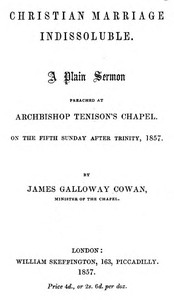
Christian Marriage Indissoluble: A Plain Sermon Preached at Archbishop Tenison's chapel, on the fifth Sunday after Trinity, 1857 — Edition Insights
(0 User reviews)
1383
Project Gutenberg
2021
Not confirmed
Sermons, English -- 19th century; Marriage -- Biblical teaching; Divorce -- Religious aspects -- Church of England; Marriage -- Religious aspects -- Church of England; Remarriage -- Religious aspects -- Church of England
Readers of public-domain and historical texts
Project Gutenberg digital edition
en
Edition facts
Words
7,299
Reading time
32 min
Text sections
1
Before opening Christian Marriage Indissoluble: A Plain Sermon Preached at Archbishop Tenison's chapel, on the fifth Sunday after Trinity, 1857 — Edition Insights, the edition data offers a quick orientation: 7,299 words, 32 min estimated reading time, and 1 detected text section.
The text analysis averages about 27.9 words per sentence, while the detected sections provide another way to judge how the source is divided.
Project Gutenberg metadata also associates the work with “Sermons, English -- 19th century,” connecting these edition facts with the source record’s subject description.
Source:
Project Gutenberg record #64733
A plain sermon preached in 1857 against a divorce bill, arguing from scripture and church tradition that Christian marriage is indissoluble, with a rhetorical shift from exegesis to urgent political warning.
Read the complete public-domain text at its original source.
Read on Project GutenbergThe sermon opens with a pointed contrast: the priest’s duty to “keep knowledge” versus the apathy that fails to proclaim God’s will during a “great moral and religious crisis.” Cowan immediately names the crisis—a bill before Parliament to allow divorce and remarriage—and frames his response not as moral reasoning but as a “religious stand” rooted in the Word of God. The voice is direct, pastoral, and combative, addressing “my brethren” as both “God’s priests and God’s people.”
Cowan’s exegesis of Matthew 19:3–6 is brief; he moves quickly to the contemporary threat. The sermon’s structure alternates between scriptural citation and pointed application, with the preacher positioning himself as a watchman against legislative encroachment on divine law.
From Exegesis to Alarm
The sermon’s opening paragraphs establish a tight link between Bible reading and political urgency. Cowan quotes Malachi’s reproof of priests who fail to teach, then pivots to the divorce bill. His language sharpens: the bill would let a guilty party “perpetuate that guilt in company with the first partner in it” and call it “Holy Matrimony.” The rhetorical escalation is deliberate—from calm exposition to a cry of alarm.
Notably, Cowan does not dwell on the Pharisees’ question in Matthew. He treats the passage as settled authority and moves to its application. The pace quickens as he introduces the bill’s specifics, using repetition (“Yea, and even more”) to heighten tension. The congregation is addressed directly, with the preacher assuming shared knowledge of the legislative context.
The Argument from Church Practice
Cowan counters a potential objection: that divorce has been tolerated for three hundred years through private acts of Parliament. He calls this a “relic of Popery,” comparing it to the Church of Rome’s practice of granting dispensations for a fee. The analogy is pointed: both systems allow the wealthy to bypass divine law.
He insists that a private act is not a precedent for a general law. The tone becomes sardonic when he dismisses the idea that past sin justifies future sin: “unless it be a good plea for continuing in sin, and plunging deeper into it, that we have already sinned.” The paragraph builds to a warning: a general law would make “the Word of God… of none effect,” and Cowan cites Prussia’s example as a cautionary tale, though he does not elaborate.
A Closing Plea and a Shift in Register
The sermon’s final paragraphs change register. Cowan acknowledges that his hearers might think he has “taken up your time unprofitably,” and he expresses regret that he cannot speak more often of “our common salvation.” This self-deprecating turn softens the earlier polemic, reminding the audience of the preacher’s pastoral role.
Yet the urgency does not dissipate. He frames the divorce bill as a threat to the very fabric of Christian marriage, and his closing words return to the image of God’s judgment: those who “would not see” are left to “grope in foul darkness.” The sermon ends not with a resolution but with a stark choice, leaving the congregation to act on the warning.
Cowan’s sermon is a specimen of mid-Victorian pulpit oratory, blending close scriptural reading with immediate political commentary. Readers should note how the preacher’s voice shifts—from exegete to alarmist to pastor—within a single discourse. The text is also valuable for its documentary record of Anglican responses to the 1857 divorce debate, revealing the rhetorical strategies used to defend marital indissolubility as both divine ordinance and social necessity.
I remember that stern 1857 sermon, its quiet urgency about vows that bind beyond the grave, and it always calls to mind the long roll of kings in The Bible, King James version, Book 13: 1 Chronicles — Context and Discussion. Both speak of covenants written in blood and duty, unchosen and irrevocable, like old friends who never needed introductions.
There are no reviews for this eBook.
There are no comments for this eBook.
Reader reflection
What did you think of this book?
Answer a few questions and save a private reflection on this device.
Your progress
0
/
10
2
How much did you enjoy the reading experience?
3
Would you encourage someone else to read it?
4
How demanding did the text feel?
5
How did the reading compare with what you expected?
6
Could you see yourself revisiting this book?
7
What was its emotional impact?
8
Would this book work well in a reading group?
9
What is the main idea you are taking away?
10