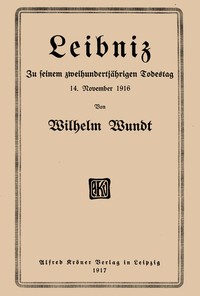
Leibniz: Zu seinem zweihunderjährigen Todestag 14. November 1916 by Wundt
Let's clear something up right away: this isn't a standard biography of the philosopher and mathematician Gottfried Wilhelm Leibniz. If you're looking for a life story from birth to death, you won't find it here.
The Story
Published to mark the 200th anniversary of Leibniz's passing, this book is a time capsule. The author, Wilhelm Wundt, was a giant in the brand-new field of experimental psychology. In 1916, with World War I raging around him, he took a step back from his usual work to ask a different kind of question. He looked at how Leibniz's ideas—about everything from calculus to metaphysics—had been understood, used, and sometimes misunderstood over two centuries. The 'plot' is the journey of an intellectual legacy. Wundt traces how Leibniz's thoughts on the mind, science, and God were filtered through the 18th and 19th centuries, right up to the turbulent early 20th century. It's the story of how one man's genius echoes through time, changing shape with each generation that listens.
Why You Should Read It
What grabbed me was the double layer of history. You're learning about Leibniz, sure, but you're also getting a powerful sense of 1916 Germany. Reading between the lines, you can feel a scholar trying to anchor his culture in a great philosophical tradition during a period of immense chaos and violence. It's surprisingly poignant. Wundt isn't just listing facts; he's actively constructing a legacy, deciding what about Leibniz matters most to his own era. It makes you think: how do we do the same thing today? Which thinkers from our past do we hold up, and what does that say about us?
Final Verdict
This is a niche but rewarding read. It's perfect for history buffs who enjoy intellectual history, or for philosophy fans curious about how ideas travel through time. It's definitely an academic work, so it requires a bit of focus, but it's not dry. You're seeing a great psychologist wrestle with the history of a great philosopher at a pivotal historical moment. If you like books that make you see the past in a new light, and appreciate a good 'book about a book about a thinker,' give this a look. Just don't expect a breezy narrative—expect a thoughtful, century-old conversation you get to quietly join.
The copyright for this book has expired, making it public property. Access is open to everyone around the world.