
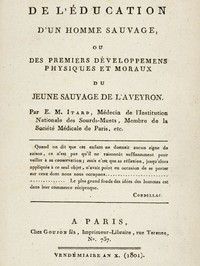
De l'éducation d'un homme sauvage by Jean Marc Gaspard Itard
In 1800, a feral child was captured in the forests of southern France and brought to Paris. He was about twelve, couldn't speak, ate like an animal, and showed no understanding of human society. Declared a hopeless case, he was sent to an institute for deaf-mutes. Enter Jean Marc Gaspard Itard, a young, idealistic doctor who refused to accept that verdict. He believed the boy—whom he named Victor—was a product of profound neglect, not inherent idiocy. For five years, Itard dedicated himself to Victor's education, documenting every step in this book.
The Story
Itard's report reads like a series of intense, personal trials. He starts with basics: clothing, using a spoon, recognizing hot and cold. The victories are tiny but monumental—the first time Victor cries real tears, his first sign of affection. The core of Itard's effort, however, is language. He devises ingenious methods to teach Victor words, believing speech is the gateway to thought and morality. The struggle here is immense. Victor learns to fetch objects when their names are written, but he never grasps the idea of asking for them himself. The book chronicles this push-and-pull: moments of stunning connection followed by long periods of what looks like stubborn reversion. It's the story of a teacher confronting the limits of his own methods and a boy whose inner world remains frustratingly, fascinatingly out of reach.
Why You Should Read It
This isn't just a historical curiosity. It's a profoundly human document that asks questions we're still wrestling with today. What is the essence of our humanity? Is it language? Empathy? Social conditioning? Itard's passion is palpable; you feel his hope, his pride, and his crushing disappointment. You also can't help but wonder about Victor's perspective. Was he learning, or was he just performing? The book forces you to sit with that ambiguity. It challenges the very idea of 'normal' and makes you think about how much of who we are is taught, not innate. It's a quiet, powerful reminder of the patience and love required to truly see another person.
Final Verdict
Perfect for readers who love narrative nonfiction that feels like a philosophical detective story. If you enjoyed books like The Immortal Life of Henrietta Lacks or are fascinated by the origins of psychology and education, you'll be gripped. It's also a must-read for anyone in teaching, psychology, or special education—a humbling look at the pioneers of their field. Be prepared: it's not a neat, happy tale. It's messy, real, and will stick with you long after you finish, making you look at the people around you a little differently.
This title is part of the public domain archive. Access is open to everyone around the world.
Aiden Martinez
11 months agoThis is one of those stories where it challenges the reader's perspective in an intellectual way. Truly inspiring.






Jennifer Ramirez
8 months agoThis is one of those stories where the narrative structure is incredibly compelling. I learned so much from this.