
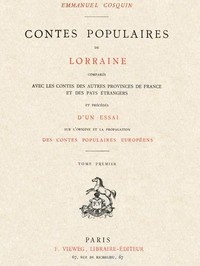
Contes populaires de Lorraine, comparés avec les contes des autres provinces de…
Okay, let's clear something up first. This isn't a storybook in the usual sense. You don't sit down to follow a single hero's journey from start to finish. Instead, think of it as a guided tour through a forest of stories, led by a super-enthusiastic and slightly nerdy guide—that's Emmanuel Cosquin.
The Story
Cosquin spent years collecting oral tales from the farmers, woodcutters, and families of Lorraine in late 1800s France. He wrote down their versions of classic tales: animal fables, quests for magical objects, stories of witches and kind-hearted youngest sons. But he didn't stop there. After each Lorraine tale, he goes on a detective hunt. He lines it up against nearly identical stories from other parts of France, from Germany's Brothers Grimm, from Slavic folklore, from the Arabian Nights, and even from ancient Sanskrit texts. His book is a massive side-by-side comparison. He's showing you, tale by tale, that the story you just read from a small French village has cousins all over the world.
Why You Should Read It
What hooked me was the sense of wonder on every page. It makes the world feel both bigger and smaller. You realize that a bedtime story told in a thatched cottage in France shares a DNA with a epic recited in a royal court in Persia. It’s humbling and exciting. Cosquin’s notes are where the magic happens. He’s not a dry academic; you can feel his excitement when he finds a link. He debates other scholars, points out tiny, fascinating variations (why is the helper a fox here but a jackal there?), and lets you in on the puzzle. Reading it, you become a detective too, starting to spot the patterns he’s talking about.
Final Verdict
This book is a treasure, but it's for a specific reader. It's perfect for folklore fans, mythology nerds, or anyone who loves the 'behind-the-scenes' of stories. If you adored dissecting fairy tales in school or get lost in Wikipedia holes about cultural myths, you'll find it endlessly rewarding. A heads-up: it's an old, scholarly work, so the language can be formal in places. But push through that, and you're rewarded with a perspective on human storytelling that feels truly magical. It’s not a quick, easy read—it’s a book to sip and savor, one fascinating tale-comparison at a time.
This content is free to share and distribute. Preserving history for future generations.
Kimberly Wright
1 year agoWow.
Melissa Garcia
8 months agoIf you enjoy this genre, it manages to explain difficult concepts in plain English. One of the best books I've read this year.

Mark Lewis
1 year agoI came across this while browsing and the pacing is just right, keeping you engaged. This story will stay with me.