
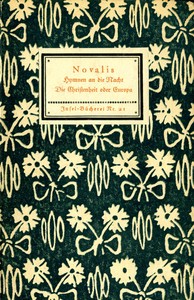
Hymnen an die Nacht / Die Christenheit oder Europa by Novalis
Let's be clear from the start: this isn't a novel with a plot in the usual sense. It's a direct line into the soul of German Romanticism, and Novalis is one of its founding voices. Reading this feels less like following a story and more like listening to someone think out loud in the most profound way possible.
The Story
The first part, Hymns to the Night, is pure poetry. It was inspired by the death of Novalis's young fiancée. He doesn't just mourn her; he transforms his grief into a cosmic love song to darkness itself. Night becomes a comforting mother, a mystical realm where the soul is freed from the harsh light of everyday reason. He sees death not as an enemy, but as a sacred passage. The second piece, Christendom or Europe, is a complete shift. It's an essay where Novalis looks back at the Middle Ages with rose-tinted glasses, imagining it as a golden age of spiritual unity under the Catholic Church. He argues that the Reformation and the Enlightenment shattered this beautiful community, leaving Europe divided and spiritually empty. His wild proposal? To rebuild that lost unity through a new, universal religion of love and poetry.
Why You Should Read It
You read this for the atmosphere and the ideas. The Hymns are breathtakingly beautiful, even in translation. They capture that specific feeling of being awake at 3 a.m., when the world is quiet and your thoughts feel huge and important. It's about finding meaning in loss. The essay is fascinating because it's so wildly impractical and sincere. Novalis isn't writing a policy paper; he's dreaming of a world healed by imagination. It's a powerful reminder that the Romantics weren't just about feelings—they had radical, sometimes naive, plans to remake society from the ground up, starting with the human heart.
Final Verdict
This book is perfect for poetry lovers, history daydreamers, and anyone interested in the roots of modern thought. It's for the reader who underlines passages that give them chills. It's not an easy beach read; it demands your attention and a willingness to sit with big, abstract ideas. But if you let it, this slim volume can open up a whole new way of seeing the world—one where night is a friend, grief is transformative, and a better future might be found by looking, strangely enough, to the mystical past.
No rights are reserved for this publication. Knowledge should be free and accessible.
Joshua Brown
1 year agoAs someone who reads a lot, the depth of research presented here is truly commendable. Worth every second.
George Wright
1 year agoI stumbled upon this title and the flow of the text seems very fluid. Definitely a 5-star read.
Susan Johnson
1 year agoA bit long but worth it.
Paul Ramirez
4 months agoWow.




Logan Brown
9 months agoThis is one of those stories where the storytelling feels authentic and emotionally grounded. Exactly what I needed.